Is the email I received from Bitvavo or is it phishing?
Phishing is an attack that attempts to steal your money, or your identity, by getting you to reveal personal information - such as credit card numbers, bank information, or passwords - on websites that pretend to be legitimate. Cybercriminals typically pretend to be reputable companies, friends, or acquaintances in a fake message which contains a link to a phishing website.
How to recognise it?
Urgent call to action or threats
Be suspicious of emails or messages that claim you must click, call, or open an attachment immediately. Often, they'll claim you have to act now to claim a reward or avoid a penalty. Creating a false sense of urgency is a common trick of phishing attacks and scams. They do that so that you won't think about it too much or consult with a trusted adviser who may warn you.
Spelling and bad grammar
Professional companies and organisations usually have an editorial staff to ensure customers get high-quality, professional content. If an email message has obvious spelling or grammatical errors, it might be a scam. These errors are sometimes the result of awkward translation from a foreign language, and sometimes they're deliberate in an attempt to evade filters that try to block these attacks.
Mismatched email domains
If the email claims to be from a reputable company, like Bitvavo or your bank, but the email is being sent from another email domain like Gmail.com, or bitvavosupport.ru it's probably a scam. Also, be watchful for very subtle misspellings of the legitimate domain name. Like bitvav0.com where the "o" has been replaced by a 0, or bItvavo.com, where the "i" has been replaced by an "I" (capital i). These are common tricks of scammers.
Suspicious links or unexpected attachments
If you suspect that an email message is a scam, don't open any links or attachments that you see. Instead, hover your mouse over, but don't click, the link to see if the address matches the link that was typed in the message. In the following example, resting the mouse over the link reveals the real web address in the box with the yellow background. Note that the string of numbers looks nothing like the company's web address.
Known examples of phishing
Phishing is an attempt to obtain your credentials in order to abuse them. This could happen in one of the following ways:
-
Per email
You receive an email which looks like it has been sent by Bitvavo, which asks you to log in to a platform which looks similar to ours, or to send your credentials for verification. Bitvavo will never send an email like this. To make sure the received email is sent by Bitvavo, you can check the anti-phishing code. More information about the anti-phishing code can be found here.
Example: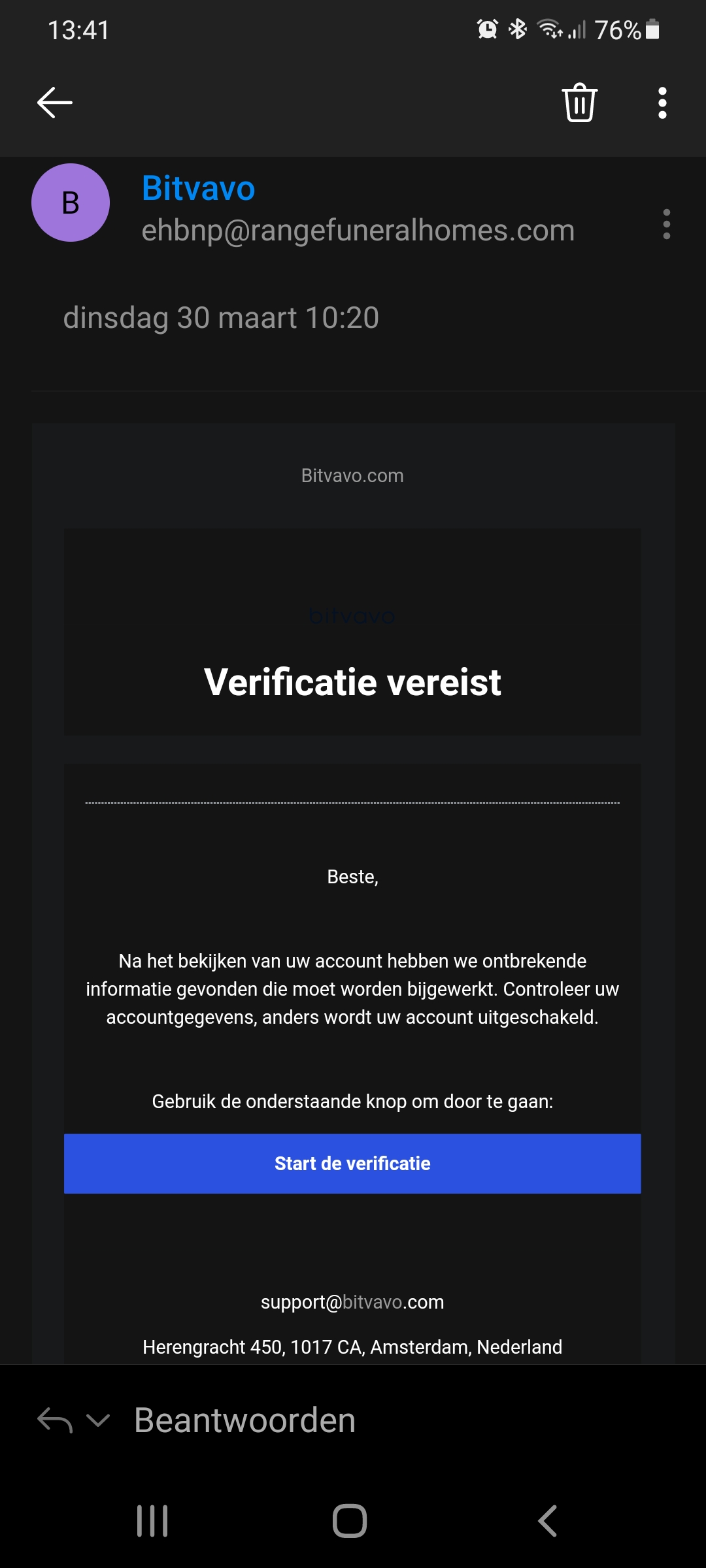
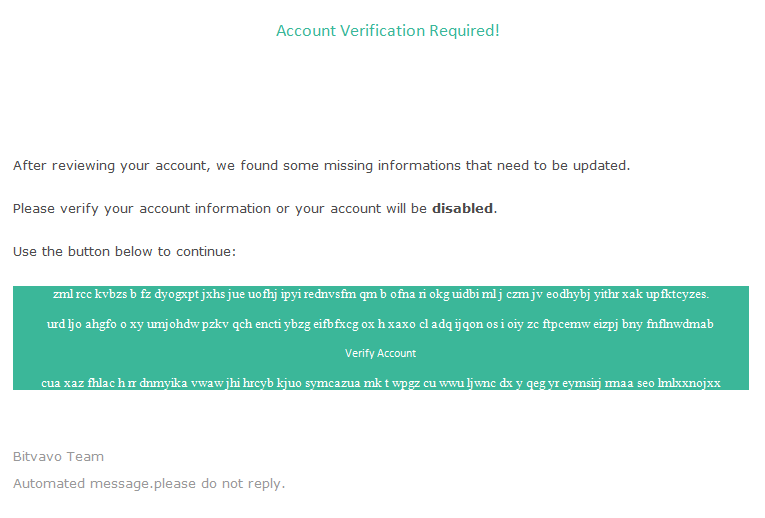
Explanation
Bitvavo would never send you emails where you have to fill in your login details or link directly to the Bitvavo platform (only to the FAQ). -
Fake websites and apps
Scammers may create fake Bitvavo websites or apps to steal your login details. Please note that Bitvavo services in the UK are exclusively available through our official mobile app. Bitvavo does not support web-based trading in the UK, so any website prompting you to log in to a Bitvavo account is a phishing attempt. Always ensure you only use the official Bitvavo app downloaded directly from the Apple App Store or Google Play Store. Never download any third-party software, profiles, or browser extensions.
Explanation:
If you encounter a website claiming to be Bitvavo or asking for your login details, do not enter any information. If you have accidentally downloaded a suspicious file or entered your details on a website, change your Bitvavo password immediately via the official app and contact our support team.
-
Per whatsapp
Bitvavo has no support via whatsapp and will never ask you to perform actions via whatsapp. Below you see some examples of someone who has received WhatsApp messages (NL) from a so called Bitvavo employee. This is not Bitvavo. -
Per phone
For security reasons, Bitvavo asks you to connect your phone number to your Bitvavo account. It could happen that, in extraordinary circumstances, Bitvavo will give you a call. However, Bitvavo will never ask for your credentials.
If you have (possibly) been a victim of phishing or if you are worried about something else, please let us know as soon as possible by sending an email to support@bitvavo.com with the subject "Urgent" so we can take action together as soon as possible to limit potential damage.
N.B. We recommend you read the following article, if you happen to have (accidentally) shared your login details as part of the aforementioned.
Why and how did I receive a phishing email?
It could be the case that your email address or phone number is available in already known data breaches on the internet. You can check your mail address or phone number (with area code +) on haveibeenpwnd.com. This doesn't cover 100%, hackers could've obtained your data in another way.
What to do now?
Verify the email I received is from Bitvavo
Please pay attention to the following characteristics and click no links before you do:
-
E-mail address
Bitvavo only sends emails from an address ending with '@bitvavo.com' or '@info.bitvavo.com' and, for marketing purposes ending with '@news.bitvavo.com'. You might also receive an email from noreply.invitations@trustpilotmail.com to review us. Additionally, leadership@bitvavo.com is a legitimate email address from Bitvavo.
-
Anti-phishing code
Every automated email that Bitvavo has sent includes an anti-phishing code. Make sure this anti-phishing code is included in the email and that it is correct.
Please note that compliance@bitvavo.com (compliance matters), support@bitvavo.com (support-related issues), fraud@bitvavo.com (fraud-related matters), and complaints@bitvavo.com (complaints) are official customer contact departments of Bitvavo. Emails sent from these addresses do not include an anti-phishing code, so it's important to stay extra vigilant. Always verify the sender and be cautious of phishing attempts.
-
Content
Bitvavo will never ask for your credentials or ask about specific account details. -
Verified sender checkmark
You can check if an email is actually from us by looking for the checkmark next to 'Bitvavo Support' in the message. This displays a pop-up confirming that the sender is the verified owner of bitvavo.com and shows our logo.
If you are still unsure whether the email you received came from us or from someone else, you can always contact our support team. You can do so by sending an email to support@bitvavo.com.
Where and how to report phishing
To best fight these phishing attacks, Bitvavo needs some more information. Email to support@bitvavo.com the following data:
- Sender (full email address);
- Full URL of any links in this email (do not click it, copy and paste).
We will try and take these websites and email addresses down as soon as possible.
What to do if you accidentally click a phishing link
When you accidentally click a phishing link, we recommend you follow the below steps as soon as possible:
- Email all data to support@bitvavo.com so we can check your account;
- Change passwords into strong and unique passwords for your email account and Bitvavo account;
- Secure your Bitvavo account in the best possible way.
Latest phishing reports
30-01-2023 Topic: Bitvavo - Actie vereist
Text: To ensure that we can continue to protect our users, we have updated our terms and conditions to comply with new and updated European Union regulations.
Should you not complete the new two-step verification within 2 days, you will no longer be able to enjoy the services you so enjoy: deposit, trade, and unlimited withdrawals.
Scan the QR code now with the camera of your mobile smartphone to perform the new two-step verification.
Was this article helpful?